
Joint Action on Personalised Cancer Medicine: OUS leads Norwegian participation in ambitious EU project
The European Joint Action on Personalised Cancer Medicine (JA PCM) officially launched on January 14, bringing together 29 European countries and over 140 partner organisations to advance personalised cancer care across Europe. Coordinated by the Belgian public health institute Sciensano, the project aims to create a sustainable cross-border network to foster innovation, equity, and collaboration in personalised cancer prevention, diagnosis, treatment, follow-up and tertiary prevention.
Oslo University Hospital (OUS) serves as the Norwegian coordinator. In addition to OUS, the Norwegian partners include the Norwegian Directorate of Health, Haukeland University Hospital and Stavanger University Hospital. Akershus University Hospital, St. Olavs Hospital and the University Hospital of North Norway also contribute with expertise via OUS. Norway plays a central role in JA PCM, and OUS leads the work package focused on treatment, as well as subprojects within diagnostics and reimbursement. Over the project period (2025-2029), JA PCM will establish new clinical trial networks and develop and test new models for data sharing and alternative pricing agreements. Piloting of platforms for diagnostics and treatment is also planned. These activities will contribute to a sustainable roadmap for implementing precision cancer medicine across Europe.
Kjetil Taskén, head of the Institute for Cancer Research at OUS and leader of the JA PCM work package on clinical trials and treatment, says:
“We aim to remove bottlenecks that hinder implementation of precision medicine in routine healthcare. Because cases are often rare in a precisionmedicine setting, we need more active, systematic data collection to support regulatory assessments and healtheconomic analyses. We therefore plan to establish a panEuropean clinical trial network for all hospitals offering precision diagnostics to attract more studies and aggregate data at the European level. We will also collect data from offlabel precision treatments and enable pricing agreements that allow early adoption alongside continued data collection.”
JAPCM builds on national and European initiatives, including the EU4Health projects PCM4EU and CanHeal as well as the EU Cancer Mission project PRIME-ROSE led by Kjetil Taskén at OUS. In recent years, Norway has invested substantially in precision cancer medicine through national infrastructures and initiatives such as InPreD (precision cancer diagnostics), the national trial IMPRESS-Norway, the public-private partnership CONNECT and MATRIX, The Norwegian Centre for Clinical Cancer Research. These efforts have strengthened Norway’s expertise and capacity in precision oncology both nationally and internationally. It is on this solid foundation that OUS has been assigned the task of leading parts of the large JAPCM initiative.
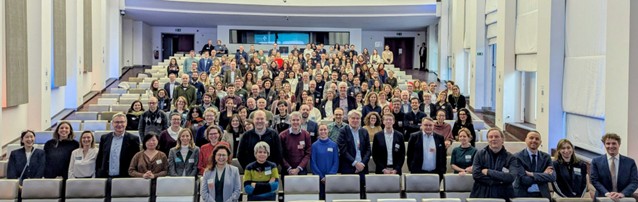
On January 14-15, the JA PCM kick off event took place in Brussels. This two-day event was opened by Frank Vandenbroucke, Belgian Minister of Public Health and Social Security, who stated that “We must facilitate the exchange of good practices and support the development of common frameworks to reduce inequalities in access to personalised cancer medicine across Europe. Innovation must not widen gaps; it must help close them."
Personalised cancer medicine is transforming how cancer is prevented, diagnosed, treated, and monitored, tailored to each patient's tumour profile, clinical history, and preferences. By addressing the entire patient pathway, JA PCM moves beyond isolated interventions and offers a patient-centred continuum of care supported by the latest science and technology.
Marc Van den Bulcke, head of the Belgian Cancer centre (Sciensano) and coordinator of JA PCM, added:
"We fully recognise that prevention, diagnosis, treatment, and follow-up should be approached in a concerted way for optimal patient benefit. Through pilots and collaborative activities, the JA PCM will support the implementation of personalised cancer medicine across Europe, building bridges between research, healthcare systems, and patient needs."
During the official kick off program, Kjetil Taskén presented plans for the Treatment work package in a talk entitled “Expanding the treatment space by access under systematic evidence-generation.” In addition, Live Fagereng, OUS, gave the presentation “Continuous data collection in a federated data sharing platform.”
A key component of the JA PCM are the concrete pilot activities and use cases that will demonstrate how precision cancer medicine can be applied in practice. In these pilots, seven major themes will be addressed:
- Pathway, access and implementation of risk-informed cancer prevention,
- Polygenic risk score application,
- Cancer genetic predisposition across the patient journey,
- Molecular tumour boards,
- Innovative shared risk treatment models with evidence generation,
- Liquid biopsy testing,
- Digital innovation for remote monitoring.
The pilots will be supported by transversal activities, such as External Quality Assessments for liquid biopsy; Education and Training, Ethical, Legal and Social Implications; Health Technology Assessment, data and access.
With its unprecedented scale, JA PCM will accelerate cross-border collaboration, strengthen European knowledge networks, form synergies with EU initiatives, and promote equitable access to personalised cancer medicine across Europe. Over the next four years, the initiative aims to create a lasting European framework for precision oncology that is sustainable, measurable, and patient-centred.
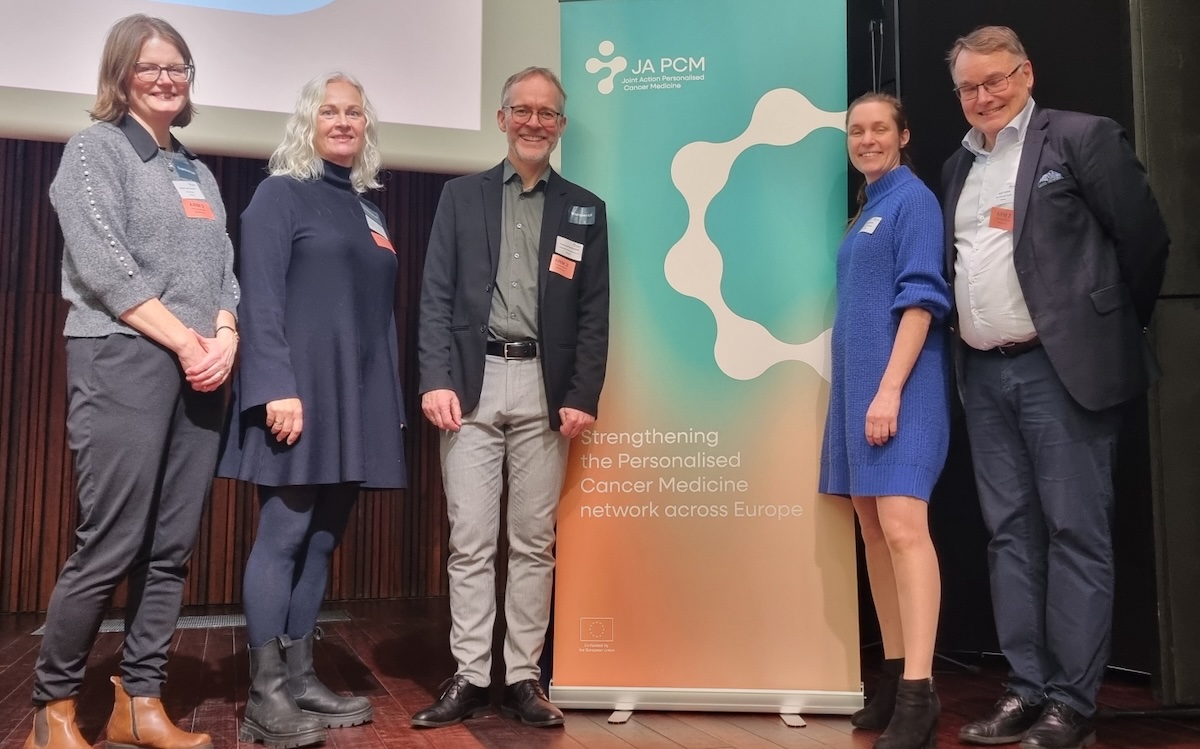
From left: Mette Myklebust (Haukeland University Hospital (HUS)), Randi Hovland (HUS), Oddmund Nordgård (Stavanger University Hospital), Live Fagereng (OUS) and Kjetil Taskén (OUS).
Links: