
Advancing Smarter and More Meaningful Biomedical Communication Networks: Three Projects Totaling NOK 36 Million Awarded to Researchers at The Intervention Centre
Artificial intelligence (AI) is transforming healthcare by enabling data-driven insights for diagnostics, treatment, monitoring, and drug discovery. But what if sensors and imaging systems could deliver only the most relevant information for a given application—simplifying data acquisition, reducing resource demands, and ensuring critical information reaches the user efficiently?
Four researchers from the Wireless Sensor Network Research Group, led by Prof. Ilangko Balasingham at The Intervention Centre, Division of Technology and Innovation, have secured three major research grants:
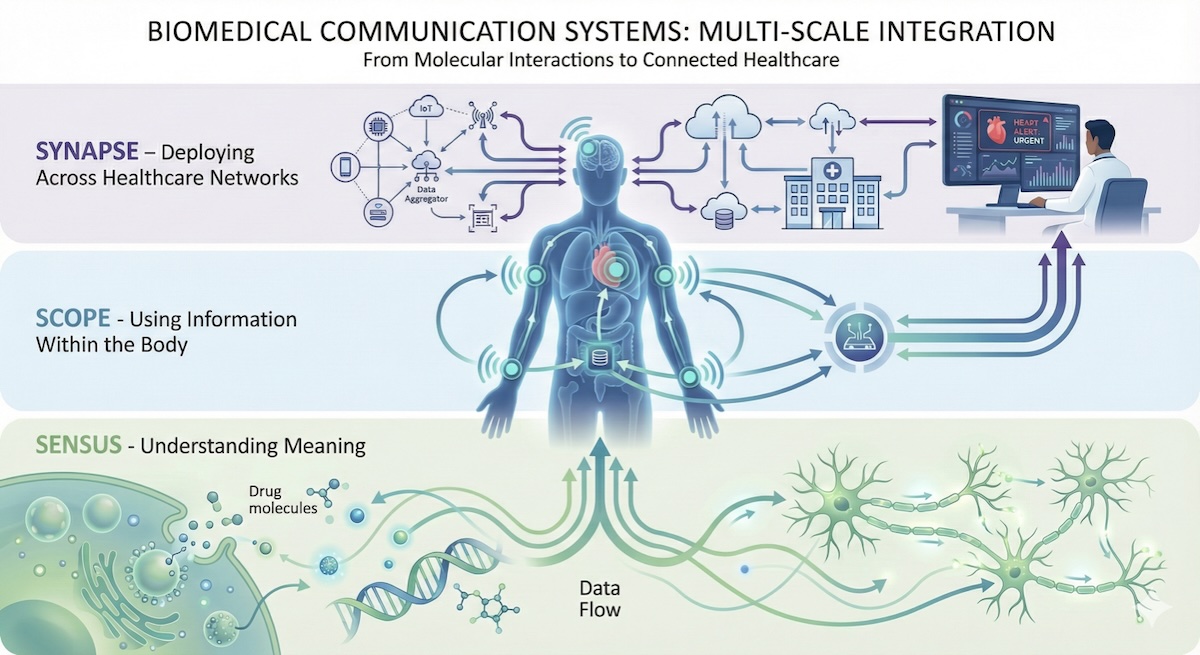
- SENSUS (Meaning-Centric Bio-Inspired Communication Systems), led by Dr. Mladen Veletic, challenges the traditional notion that communication quality is defined by accuracy. Instead, it explores a meaning-centric, bio-inspired paradigm for intra-body biomedical applications, including validation of theories for targeted drug delivery.
- SCOPE (Semantic Feature-Based Communication and Control for Wireless Body Sensor-Actuator Networks), led by Prof. Ilangko Balasingha and Dr. Mohammad Zoofaghari, extends this concept to wireless body sensor-actuator networks. The project will pioneer semantic feature-based methodologies for resource-constrained intra-body communications, optimal resource allocation, real-time adaptability, and resilience.
- SYNAPSE (SYnergetic Network-AI Platform for Semantic Efficiency), led by Dr. Roufaida Laidi, focuses on creating an AI-native ecosystem where distributed intelligence and network infrastructure co-evolve in real time. Applied to remote patient monitoring, SYNAPSE will enable networks that automatically recognize and prioritize life-critical data—ensuring urgent health alerts receive immediate attention over routine measurements.
Each project has been awarded NOK 12 million by the Research Council of Norway, totaling NOK 36 million, under the call for Enabling Technologies: Renewal and Development of ICT. Together, these projects aim to revolutionize biomedical communication systems by introducing semantic intelligence across different layers—from understanding the meaning of information, to applying it within the body, to deploying it across distributed healthcare networks.

Links:
Wireless Sensor Network Research Group, led by Prof. Ilangko Balasingham
From the Research Council of Norway:
Researcher Project for ICT Renewal and Development