Welcome to Jorrit Enserink's research group

Budding yeast   Coming soon: the genetic network of CDK1!

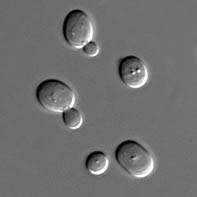
Research in my group focuses on processes that are regulated by the cell cycle. We make use of a model organism, S. cerevisiae, which is commonly known as budding yeast. Budding yeast is easily genetically manipulated, and powerful tools have been developed to characterize the cell's genetic and biochemical networks. Importantly, basic regulation of the eukaryotic cell cycle has remained unchanged over the past ~ 1 billion years of evolution. Therefore, budding yeast is an excellent model system for studying eukaryotic cell cycle regulation. See here for a brief overview of the history of yeast as a model organism (this article appeared in NBS Nytt, Nr.1 2012).

The cell cycle is orchestrated by cyclin dependent kinases (CDKs). A single CDK, Cdk1 (also known as Cdc28), is sufficient for cell cycle control in S. cerevisiae. While the upstream regulation of Cdk1 is relatively well understood, the downstream targets of Cdk1 that execute the processes involved in cell cycle progression have remained much more obscure. Thus far, over 75 targets of Cdk1 have been identified (for a recent open access review see here). Despite this relatively large number, these targets cannot explain the enormous complexity of cell duplication. Two major challenges are: unraveling the genetic network of the cell cycle, and identification of the targets of Cdk1.

In addition, we study the functions of CDKs in cancer cells. Various CDKs, in particular Cdk2, Cdk4 and Cdk6, are aberrantly activate in most -if not all- cancers. Furthermore, various oncogenes, including Ras, require the activity of CDKs for proliferation and survival of cancer cells, and overexpression of cyclins contributes to resistance to cancer chemotherapy. The systematic identification of the pathways that cooperate with CDKs during oncogenesis will contribute to the development of novel cancer therapy. We use the knowledge obtained from our studies in yeast to identify these pathways.


The objectives of my lab are:

1.  To determine how a cell responds to environmental stimuli, especially in terms of dynamic changes in transcription, and how this affects cell cycle progression.

2.  To unravel the genetic network of the cell cycle and to characterize novel Cdk1 targets in order to get a better understanding of cell cycle regulation.

3. To identify signaling pathways that cooperate with CDKs to maintain cell viability in cancer cells.


Selected publications (for a complete list see here):

 1. A chemical-genetic screen to unravel the genetic network of CDC28/CDK1 links ubiquitin and Rad6-Bre1 to cell cycle progression.
Zimmermann C, Chymkowitch P, Eldholm V, Putnam CD, Lindvall JM, Omerzu M, Bjørås M, Kolodner RD, Enserink JM*
Proc Natl Acad Sci U S A. 2011 Nov 15;108(46):18748-53
*Corresponding author

2. An overview of Cdk1-controlled targets and processes.
Enserink JM*, Kolodner RD.
Cell Div. 2010 May 13;5:11 (review)
*Corresponding author

3. The Saccharomyces cerevisiae Rad6 postreplication repair and Siz1/Srs2 homologous recombination-inhibiting pathways process DNA damage that arises in asf1 mutants.
Kats ES, Enserink JM, Martinez S, Kolodner RD.
Mol Cell Biol. 2009 Oct;29(19):5226-37

4. Cdc28/Cdk1 positively and negatively affects genome stability in S. cerevisiae.
Enserink JM, Hombauer H, Huang ME, Kolodner RD.
J Cell Biol. 2009 May 4;185(3):423-37

5. An FHA domain-mediated protein interaction network of Rad53 reveals its role in polarized cell growth.
Smolka MB, Chen SH, Maddox PS, Enserink JM, Albuquerque CP, Wei XX, Desai A, Kolodner RD, Zhou H.
J Cell Biol. 2006 Dec 4;175(5):743-53

6. Checkpoint proteins control morphogenetic events during DNA replication stress in Saccharomyces cerevisiae.
Enserink JM, Smolka MB, Zhou H, Kolodner RD.
J Cell Biol. 2006 Dec 4;175(5):729-41

7. The cAMP-Epac-Rap1 pathway regulates cell spreading and cell adhesion to laminin-5 through the alpha3beta1 integrin but not the alpha6beta4 integrin.
Enserink JM, Price LS, Methi T, Mahic M, Sonnenberg A, Bos JL, Taskén K.
J Biol Chem. 2004 Oct 22;279(43):44889-96

8. Cyclic AMP induces integrin-mediated cell adhesion through Epac and Rap1 upon stimulation of the beta 2-adrenergic receptor.
Rangarajan S, Enserink JM**, Kuiperij HB, de Rooij J, Price LS, Schwede F, Bos JL.
J Cell Biol. 2003 Feb 17;160(4):487-93
**Shared first authorship

9. A novel Epac-specific cAMP analogue demonstrates independent regulation of Rap1 and ERK.
Enserink JM, Christensen AE, de Rooij J, van Triest M, Schwede F, Genieser HG, Døskeland SO, Blank JL, Bos JL.
Nat Cell Biol. 2002 Nov;4(11):901-6