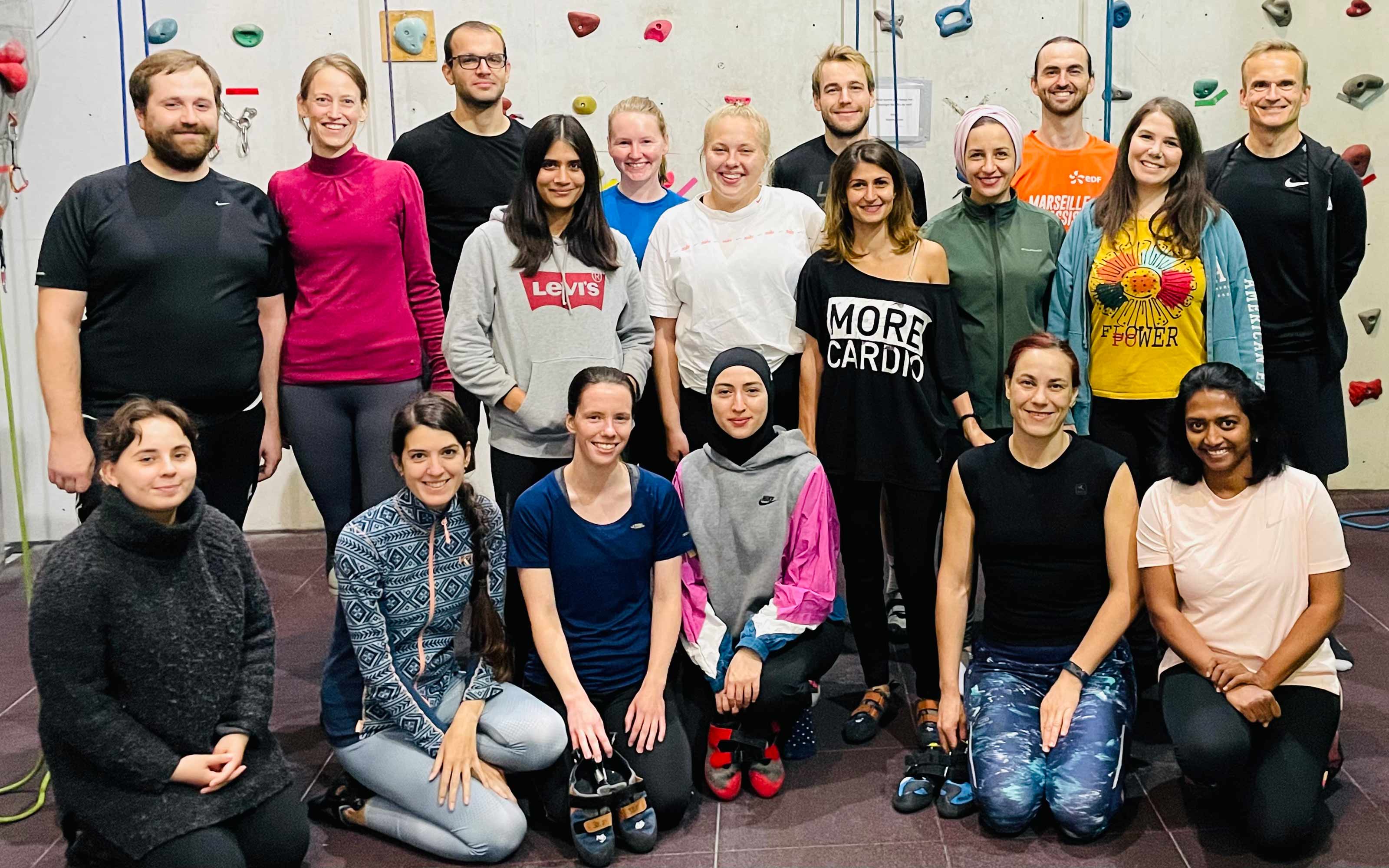
Welcome to Jorrit Enserink's research group
![]() |
![]() |
|
Lab Goal
Cells are continuously exposed to changes in their environment. For optimal growth and survival, cells have developed mechanisms that sense these alterations and generate responses that maintain cellular homeostasis. A major response to environmental stimuli is transcriptional reprogramming. The lab’s main goal is to understand how cells cope with environmental changes, in particular in terms of regulation of transcription.
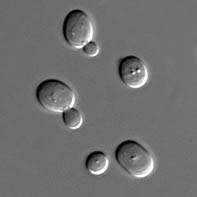
We mainly focus on regulation of transcription by post-translational modifications, such as phosphorylation, ubiquitination and sumoylation, and we primarily use the model organism Saccharomyces cerevisiae for our studies.
Previous findings
Rad6 in transcription and cell cycle regulation
Using a high-throughput chemical-genetic screen, we recently found that the E2 ubiquitin conjugase Rad6 is temporally recruited to promoter regions of cyclin genes, where it ubiquitinates histone H2B (Fig. 1). This promotes transcription of cyclins, thereby activating the cyclin dependent kinase Cdk1 to promote efficient cell cycle entry.
![]() |
| Figure 1. Cell cycle regulation by Rad6. (A) Cell cycle entry is initiated by phosphorylation of Whi5 by Cln3-Cdc28, which leads to nuclear exclusion of Whi5 and activation of SBF. SBF activates the G1 transcriptional program, which includes the cyclins CLN1 and CLN2, which in a positive feedback loop further phosphorylate and inhibit Whi5 to induce efficient cell cycle entry. (B) Doa1 supplies ubiquitin to the pool of free ubiquitin. Rad6 forms a link between the pool of free ubiquitin and the cell cycle by promoting transcription of cyclins. (C) Cdc48 promotes cell cycle progression in at least two ways. It promotes degradation of Far1, presumably through its binding partners Ufd1 and Npl4. This relieves the inhibition of Cln-Cdc28 complexes, in particular when cells recover from pheromone-induced cell cycle arrest. In addition, Cdc48 promotes cell cycle progression by increasing the expression of cyclins through the Doa1-ubiqtuin-Rad6-Bre1 pathway. |
Cdk1 in regulation of transcription
We recently discovered that Cdk1 has a kinase-dependent function in regulation of the basal transcription machinery. Using ChIP-seq, we found that Cdk1 localizes to highly transcribed genes, primarily involved in housekeeping. At these genes, Cdk1 cooperates with another CDK, Kin28 (the catalytic subunit of TFIIH), to phosphorylate RNA polymerase II (Fig. 2). RNA polymerase II has a long C-terminal domain that consists of 28 repeats of the sequence Y1S2P3T4S5P6S7. Cdk1 and Kin28 promote phosphorylation of the serine residue at position 5 (Ser5). This in turn is important for efficient recruitment of the capping machinery, which places a cap on the mRNA as soon as it protrudes from the polymerase.
|
Figure 2. A model for cooperation between Cdk1 and Kin28 in regulation of RNA polymerase II. (A) Kin28 phosphorylates the C-terminal domain of RNA pol II, which may result in recruitment of Cdk1, which further phosphorylates RNA pol II (B). |
Ongoing research
Sumoylation and cell stress
We want to understand how cells modulate transcription in response to environmental changes, in particular nutrient starvation. We are particularly interested in the role of the ubiquitin family protein Sumo. Sumoylation is clearly important in rewiring of transcription in response to cell stress. However, which proteins are sumoylated and how Sumo regulates their function remains mysterious. By performing ChIP-seq experiments and mass spectrometry we have identified a number of proteins that become sumoylated during cell stress. We are currently studying the molecular mechanism by which Sumo modulates the activity of these proteins to regulate transcription.
Regulation of transcription by signal transduction kinases
Another major focus of the group is to determine how kinases regulate transcription. In response to specific environmental cues, signaling pathways rewire transcriptional programs to make sure the cell optimally responds to changes in conditions. These signaling pathways often consist of kinases. However, how these kinases control transcription is not well understood. Using a combination of ChIP-seq, mass spectrometry and fluorescence microscopy we are unraveling the molecular mechanisms by which signaling kinases control transcription.
Non-yeast projects
We are also studying the effect of various oncogenes on re-wiring of transcriptional programs. Many oncogenes have profound effects on gene expression, but exactly how they regulate the transcription machinery is not well understood.
Institutions that finance our research
Research in the Enserink group, as well as salaries for all the lab members including the PI, is entirely financed by extramural grants from the Norwegian Research Council, The Norwegian Cancer Society and by the Norwegian Health Authority South-East.
Selected publications (for a complete list see here):
1. Cdc28 kinase activity regulates the basal transcription machinery at a subset of genes.
Chymkowitch P, Eldholm V, Lorenz S, Zimmermann C, Lindvall JM, Bjørås M, Meza-Zepeda L, Enserink JM*
Proc Natl Acad Sci U S A. 2012, in press
*Corresponding author
2. A chemical-genetic screen to unravel the genetic network of CDC28/CDK1 links ubiquitin and Rad6-Bre1 to cell cycle progression.
Zimmermann C, Chymkowitch P, Eldholm V, Putnam CD, Lindvall JM, Omerzu M, Bjørås M, Kolodner RD, Enserink JM*
Proc Natl Acad Sci U S A. 2011 Nov 15;108(46):18748-53
*Corresponding author
3. What makes the engine hum: Rad6, a cell cycle supercharger.
Enserink JM* and Kolodner RD
Cell Cycle. 2012 Jan 15;11(2):249-52.
*Corresponding author
4. An overview of Cdk1-controlled targets and processes.
Enserink JM*, Kolodner RD
Cell Div. 2010 May 13;5:11 (review)
*Corresponding author
5. The Saccharomyces cerevisiae Rad6 postreplication repair and Siz1/Srs2 homologous recombination-inhibiting pathways process DNA damage that arises in asf1 mutants.
Kats ES, Enserink JM, Martinez S, Kolodner RD
Mol Cell Biol. 2009 Oct;29(19):5226-37
6. Cdc28/Cdk1 positively and negatively affects genome stability in S. cerevisiae.
Enserink JM, Hombauer H, Huang ME, Kolodner RD
J Cell Biol. 2009 May 4;185(3):423-37
7. An FHA domain-mediated protein interaction network of Rad53 reveals its role in polarized cell growth.
Smolka MB, Chen SH, Maddox PS, Enserink JM, Albuquerque CP, Wei XX, Desai A, Kolodner RD, Zhou H
J Cell Biol. 2006 Dec 4;175(5):743-53
8. Checkpoint proteins control morphogenetic events during DNA replication stress in Saccharomyces cerevisiae.
Enserink JM, Smolka MB, Zhou H, Kolodner RD
J Cell Biol. 2006 Dec 4;175(5):729-41
9. The cAMP-Epac-Rap1 pathway regulates cell spreading and cell adhesion to laminin-5 through the alpha3beta1 integrin but not the alpha6beta4 integrin.
Enserink JM, Price LS, Methi T, Mahic M, Sonnenberg A, Bos JL, Taskén K
J Biol Chem. 2004 Oct 22;279(43):44889-96
10. Cyclic AMP induces integrin-mediated cell adhesion through Epac and Rap1 upon stimulation of the beta 2-adrenergic receptor.
Rangarajan S, Enserink JM**, Kuiperij HB, de Rooij J, Price LS, Schwede F, Bos JL
J Cell Biol. 2003 Feb 17;160(4):487-93
**Shared first authorship
11. A novel Epac-specific cAMP analogue demonstrates independent regulation of Rap1 and ERK.
Enserink JM, Christensen AE, de Rooij J, van Triest M, Schwede F, Genieser HG, Døskeland SO, Blank JL, Bos JL
Nat Cell Biol. 2002 Nov;4(11):901-6
![]() |
![]() |
Focus on recruitment and career building in health research
May 24, 2013
Latest PubMed articles
The cell cycle rallies the transcription cycle: Cdc28/Cdk1 is a cell cycle-regulated transcriptional CDK
Transcription, 4 (1), 3-6
PubMed 23131667
Chemical genetics: budding yeast as a platform for drug discovery and mapping of genetic pathways
Molecules, 17 (8), 9258-73
PubMed 22858845
Cdc28 kinase activity regulates the basal transcription machinery at a subset of genes
Proc Natl Acad Sci U S A, 109 (26), 10450-5
PubMed 22689984
More publications


Print this page